Finnish Lapland is one of those destinations that travellers think they understand before they arrive. The images are already familiar: snow-covered forests, reindeer, huskies, glass cabins, steaming saunas and Santa Claus Village in Rovaniemi. It’s the version of Arctic winter that seems to come pre-wrapped, complete with soft light, frozen lakes and the possibility of the Northern Lights appearing just when the camera is ready.
That familiarity is part of its appeal. Finnish Lapland is easy for clients to imagine, especially families and first-time winter travellers. It has a clear emotional hook and a strong sense of place. But the destination becomes far more interesting when you move beyond the obvious. Finnish Lapland isn’t just “the Santa trip,” and it isn’t only a backdrop for aurora photography. Its real strength lies in the way it introduces travellers to Arctic winter without overwhelming them.
Compared with the sharper drama of Norwegian Lapland or the more elemental wilderness feel of Swedish Lapland, Finnish Lapland has a gentler character. The landscapes are softer, the fells are more rounded, the forests feel intimate, and the pace can be shaped in a way that works beautifully for families, couples, small groups and multi-generational travellers. It offers proper winter, but it doesn’t demand expedition-level appetite from the people experiencing it.
That balance is what makes Finnish Lapland such a useful destination to understand. It can deliver the magic clients expect while quietly offering much more: deep sauna culture, boreal forest, reindeer traditions, frozen lakes, wilderness cabins, ice roads and a landscape whose colour and silence are often more memorable than the headline activities.
Rovaniemi Is The Entry Point, But Not The Whole Story
Rovaniemi gives Finnish Lapland its most recognizable identity. As the official hometown of Santa Claus, it has become one of Europe’s clearest family winter draws. For parents planning a festive or school-holiday trip, that clarity matters. There’s very little translation required. Children understand the appeal immediately, and adults can see the logic of a destination that combines fantasy with real winter experiences.
Santa Claus Village is the obvious anchor, but it shouldn’t be treated as the entire reason to go. The strongest Rovaniemi programmes use it as one part of a fuller Arctic journey. A family might begin with Santa, but what they often remember just as strongly is the first husky ride through snow-covered forest, the warmth of a sauna after being outside, a reindeer encounter, a candlelit dinner, or the strange thrill of standing on a frozen lake.
This is where Finnish Lapland becomes more than festive travel. It gives children the storybook version of winter, but it gives adults atmosphere, texture and contrast. The destination works because it can satisfy both levels at once. It can be playful without becoming shallow, and practical without losing the sense of wonder.
That makes it especially valuable for travel planning. Many families want the magic, but they also need comfort, pacing and reliability. Rovaniemi provides the infrastructure that helps make Arctic winter feel approachable: accommodation, restaurants, transfers, activity operators and enough visitor services to keep the experience manageable. For first-time Arctic travellers, that softer landing can make all the difference.
The Landscape Is Gentle, And That’s A Strength
One of the defining features of Finnish Lapland is its terrain. The Finnish fells, known as tunturi, are gentler and more rounded than the steep mountains and fjords travellers might associate with Norway. This gives Finnish Lapland a very different mood. It doesn’t have the same visual drama as a jagged coastline or a mountain dropping into the sea, but it offers something quieter and often more accessible.
That gentleness is not a weakness. For many clients, it’s exactly the point. Families with younger children, older travellers, nervous snow travellers and soft-adventure clients often need winter to feel exciting without feeling physically intimidating. Finnish Lapland can provide that. The activities still feel special, but the overall environment is less severe than some other Arctic destinations.
A dog sledding experience through dense boreal forest feels adventurous, but not necessarily extreme. A reindeer farm stay can feel culturally rich and atmospheric without being physically demanding. Snowshoeing can be gentle rather than strenuous. Sauna and winter wellness experiences can be built around comfort and contrast rather than endurance.
This is why Finnish Lapland is such a strong introduction to Nordic winter. It allows travellers to feel that they’ve entered the Arctic, while still giving them a sense of security and warmth. The snow is real. The cold is real. The landscapes are real. But the experience can be shaped so that clients are drawn into winter rather than tested by it.
The Forest Gives Winter Its Character
Dog sledding is one of the most familiar activities in Finnish Lapland, but the setting is what gives it its particular feeling. The dense boreal forest creates an atmosphere that’s very different from open mountain terrain. Snow gathers on branches, the trail narrows, and the sled seems to move through corridors of white. It can feel enclosed, quiet and almost cinematic.
For many travellers, the most striking part of a husky experience isn’t the speed. It’s the shift in sound. Before departure, the dogs are often loud, restless and full of energy. Once the sled begins to move, the noise changes. The runners slide over the snow, the forest closes around the route, and the rhythm becomes strangely calm. It’s one of those moments where travellers stop observing the landscape and feel carried into it.
The forest also changes how people experience silence. Snow absorbs sound, which gives Finnish Lapland a padded stillness that can be difficult to explain in advance. Clients may ask about the Northern Lights or Santa Claus Village, but the quiet of the forest is often one of the details that stays with them. It’s not a dramatic selling point in the usual sense, but it’s deeply felt once they’re there.
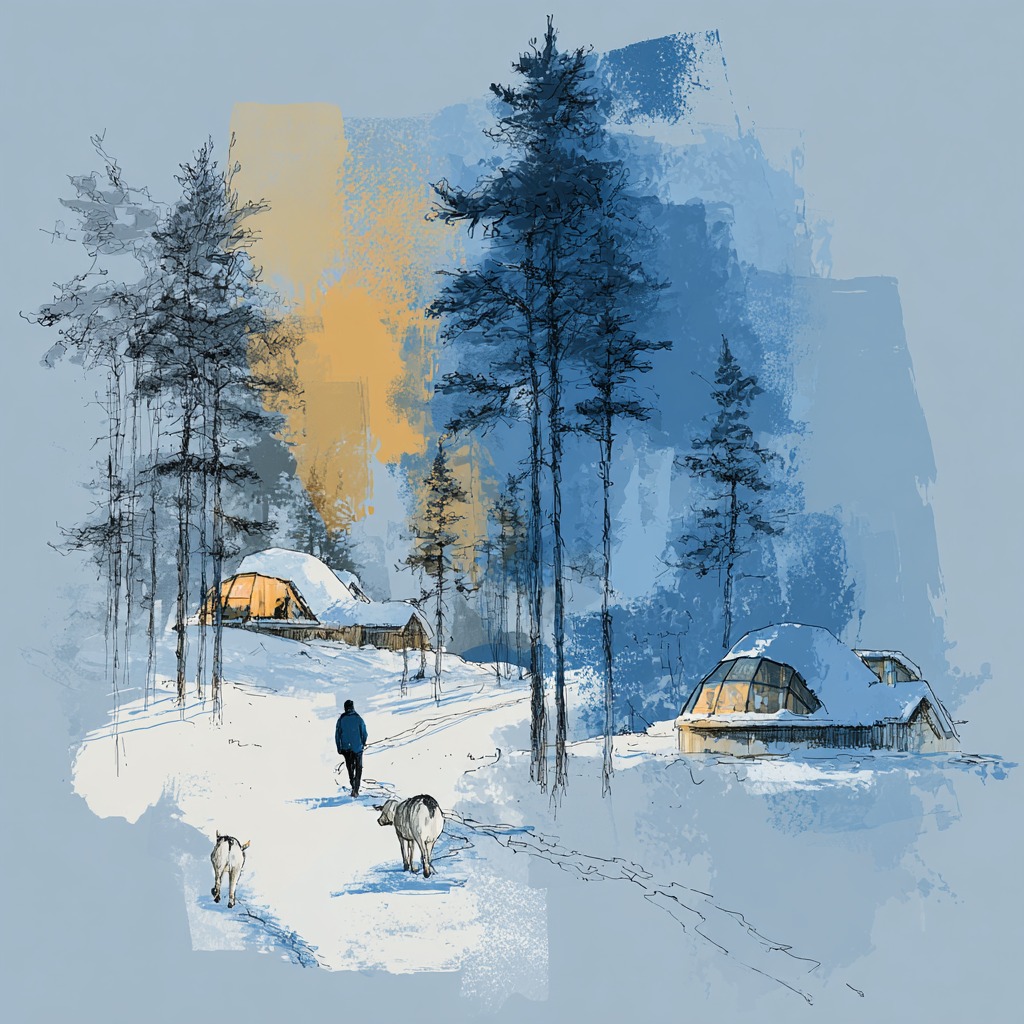
This is also where Finnish Lapland’s visual personality comes through. Travellers expect white, but the landscape isn’t only white. Frozen bogs and birch forests can hold warm, burnt-orange tones even beneath snow, especially in low winter light. Against blue shadows and pale skies, those colours give the landscape an otherworldly softness. It’s not the postcard version of winter. It’s stranger and more beautiful than that.
Reindeer Encounters Add More Than A Photo Opportunity
Reindeer are so closely associated with Lapland that it’s easy to treat them as part of the scenery. That would be a mistake. Reindeer encounters and farm stays can add an important cultural layer to a Finnish Lapland itinerary, especially when they’re handled with care and context.
A reindeer experience is usually slower and quieter than dog sledding or snowmobiling. That pace matters. It gives the itinerary a different emotional texture. Travellers aren’t just moving quickly through the landscape. They’re pausing, listening, feeding the animals, learning about local life and understanding how deeply reindeer are tied to northern identity and tradition.
For families, these encounters create immediate wonder. For adults, they can offer a more grounded understanding of the region. The experience becomes richer when it’s not presented as a cute animal stop, but as part of a living landscape where people, animals, weather and tradition are connected.
Reindeer experiences also help balance a winter programme. Not every day should be built around adrenaline. Some of the strongest itineraries alternate between active experiences and slower, more reflective ones. In Finnish Lapland, that balance comes naturally: huskies one day, reindeer the next; snow and movement followed by fire, food and conversation.
Sauna Is Not A Wellness Trend Here
Sauna culture is one of the most important parts of Finnish winter, and it should be understood as more than an add-on. In Finland, sauna is not a decorative spa feature. It’s part of daily life, part of social life and part of how people live with the climate. In winter, that becomes especially clear.
After time outside in sub-zero temperatures, the movement into heat feels almost ceremonial. The body warms, the breath slows, and the cold outside stops feeling like an enemy. It becomes part of a rhythm: cold air, heat, steam, maybe snow or cold water, then heat again. Travellers begin to understand that winter in Finland isn’t something people simply endure. It’s something they know how to answer.
Smoke sauna traditions add even more depth. They carry a stronger sense of heritage and atmosphere than many visitors expect: dark wood, soft heat, the smell of smoke and a slower pace that feels far removed from the polished language of modern wellness. For clients interested in wellbeing, this is one of Finnish Lapland’s strongest assets. It’s not wellness imported into the destination. It belongs there.
Sauna also works across audiences. Couples can experience it as quiet and intimate. Families can approach it gently as part of Finnish life. Groups can use it as a shared ritual that doesn’t rely on sightseeing. After a day outdoors, it often becomes one of the most memorable parts of the trip.

The Less Obvious Experiences Are Often The Ones That Surprise People
Finnish Lapland has plenty of familiar winter experiences, but some of its most interesting moments are less widely understood. Ice road driving is a good example. In the right conditions, frozen lakes can become legally marked routes, allowing vehicles to drive across the lake surface. For travellers from warmer countries, the idea is astonishing. A lake becoming a road changes their understanding of what winter can do to a landscape.
Of course, this is not something to present casually. Ice road driving depends on conditions, safety, official markings and local knowledge. But when it works, it offers one of those rare travel moments that feels both practical and surreal. It shows how Arctic winter changes not just the scenery, but the way people move through it.
Wilderness cabins offer another side of Finnish Lapland that’s worth taking seriously. Cabin culture is deeply rooted in Finnish life, and a genuine wilderness stay can be one of the most powerful ways to experience the region. For the right traveller, the appeal is not luxury in the conventional sense. It’s privacy, simplicity, silence and distance from everything unnecessary.
That kind of experience isn’t for every client. Some people need full service, easy restaurant access and structured daily activity. Others are genuinely drawn to the idea of seeing no one for days, sitting by a fire, stepping outside into snow, cooking simply, watching the sky and letting the quiet do its work. In an over-connected world, that can feel like a rare form of luxury.
This is one of the reasons Finnish Lapland has such range. It can be festive and family-friendly, but it can also be remote, stripped back and deeply calm. Those two qualities are not opposites. They’re part of the same destination.
Finnish Lapland Works Best When The Pace Is Right
The temptation with Finnish Lapland is to overfill the itinerary. The ingredients are all appealing: Santa Claus Village, huskies, reindeer, snowmobiling, sauna, Northern Lights, ice fishing, snowshoeing, glass cabins, frozen lakes, wilderness stays and more. On paper, it can all look possible.
In practice, winter travel needs more space than summer travel. Getting dressed properly takes time. Outdoor activity uses more energy than people expect. Children need breaks. Adults need breaks too, even when they don’t admit it. Darkness changes the pace of the day, and weather can affect what’s possible.
A good Finnish Lapland programme doesn’t need to include everything. It needs to make the right things feel unhurried. One strong outdoor activity, one warm meal, one gentle cultural experience and one quiet evening can be more effective than a day packed with back-to-back inclusions. The magic often comes from giving each experience enough room to settle.
This is particularly important for family travel. Children may love the snow, but they can also get tired quickly in the cold. Parents may want the trip to feel full, but they also want it to feel smooth. Grandparents may enjoy the atmosphere, but not necessarily a physically demanding schedule. Finnish Lapland can serve all of them well, but only if the pacing is carefully considered.
The destination rewards restraint. It doesn’t need to be forced into constant motion. Its strongest quality is the way it lets people slow down without feeling bored.
The Northern Lights Matter, But They Shouldn’t Carry The Trip
Many travellers come to Finnish Lapland hoping to see the Northern Lights. That hope is completely understandable. The image of the aurora above a snowy forest or glass-roofed cabin is one of the most powerful in Nordic winter travel.
But it’s important to be honest about what the aurora is and isn’t. It’s not a scheduled show. Cloud cover, solar activity, location and timing all matter. Sometimes the sky performs beautifully. Sometimes it doesn’t. A Finnish Lapland itinerary should never depend entirely on one sky-dependent moment.
The best trips treat the aurora as the great possibility, not the whole promise. If the lights appear, they become the unforgettable flourish. If they don’t, the journey should still feel complete. That means the rest of the itinerary needs real substance: forest, food, reindeer, huskies, sauna, snow, warmth, silence and time to feel the region properly.
Finnish Lapland is well suited to this because its appeal is not only visual spectacle. It’s atmospheric. It works through contrast and rhythm: cold and heat, darkness and candlelight, activity and quiet, forest and fire. The aurora may be the headline, but it isn’t the only reason the trip has value.
Why Finnish Lapland Stays With Travellers
The obvious reasons to visit Finnish Lapland are easy to name. Santa Claus Village, dog sledding, reindeer farm stays, deep sauna culture, frozen lakes, snow-covered forests and the Northern Lights all create a very strong winter proposition.
But the destination often stays with travellers for quieter reasons. The burnt-orange colour of birch and bog under snow. The feeling of warm air after stepping inside from minus 20. The moment a husky team falls into rhythm. The stillness of a frozen forest. The first time a child sees snow deeper than anything they’ve known at home. The simple strangeness of standing on a lake that has become solid enough to cross.
That’s the real strength of Finnish Lapland. It meets the expectation of winter magic, then gives travellers something more grounded and lasting. It’s accessible without being ordinary. It’s gentle without being dull. And it’s magical without needing to be manufactured at every turn.
For families, it can be unforgettable. For first-time Arctic travellers, it can be the perfect beginning. And for anyone who thinks winter travel is just about being cold, Finnish Lapland offers a better answer.
Here, winter isn’t something to get through.
It’s the reason to go.