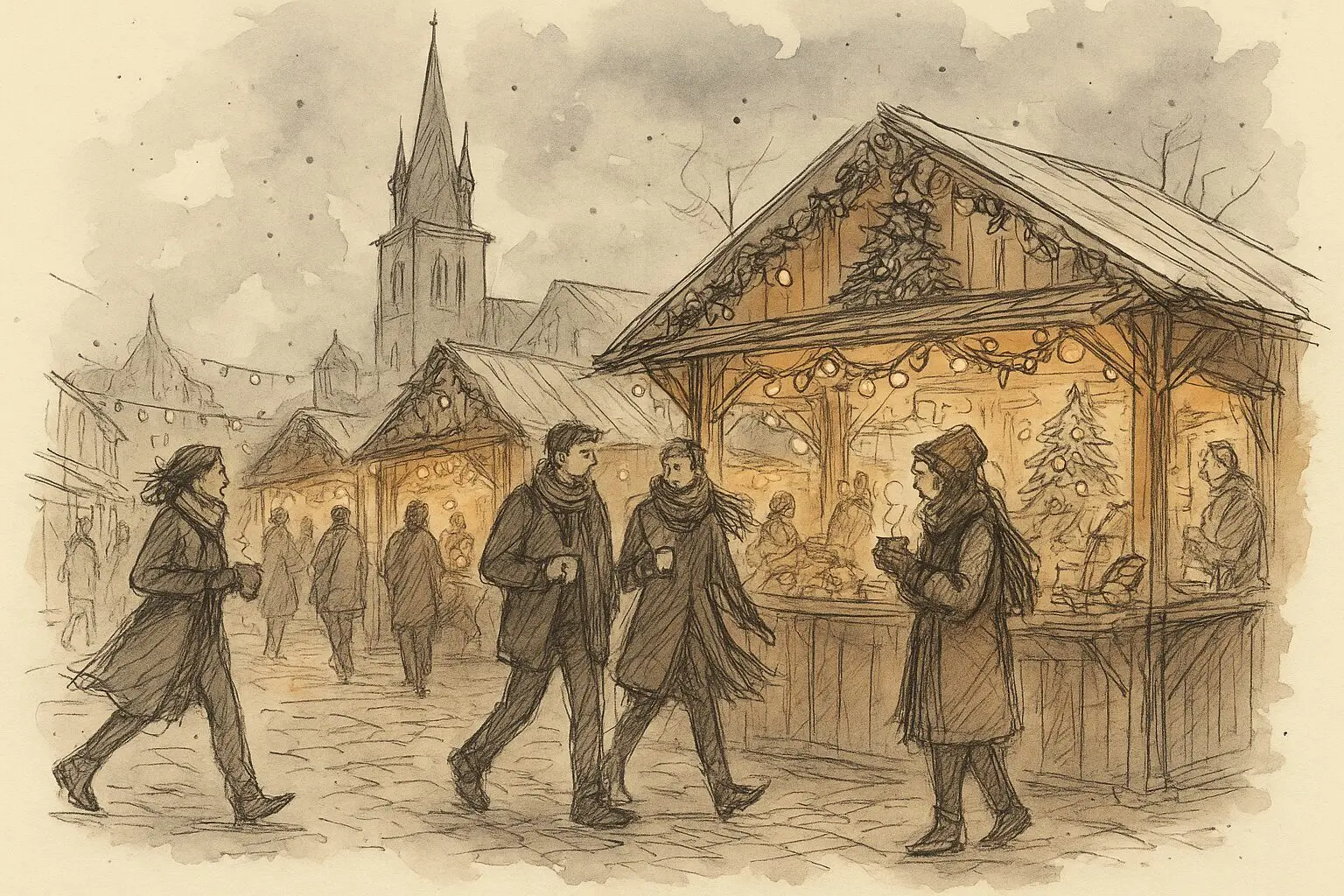
Europe in December feels like it was built for fairy lights and mulled wine. Town squares turn into lantern-lit villages, steam curls up from food stalls, and cathedral spires frame ice rinks and Christmas trees. For travellers, Christmas markets are no longer a nice extra. They’re fast becoming a reason to travel in their own right.
There are thousands of markets across the continent, but some stand out for history, setting, and sheer atmosphere. Below is a practical guide to Europe’s standout Christmas markets, with notes that work for both independent travellers and group itineraries.

Vienna, Austria – The Classic Christmas Capital
Vienna regularly appears near the top of “best Christmas market” lists for good reason. The city doesn’t have one market but a whole circuit of them, from the grand Christkindlmarkt in front of the Rathaus to atmospheric spots at Schönbrunn Palace, Belvedere, Karlsplatz and Stephansplatz.
What makes it special
- Long tradition of advent and winter markets, with roots going back to the 13th century.
- Multiple markets within easy walking or tram distance.
- Strong emphasis on classical music, choral performances and Viennese patisserie.
Travel tip
Vienna is ideal for multi-night stays: you can build a soft “market trail” itinerary where groups visit a different market each evening after daytime sightseeing.
Strasbourg, France – “Capital of Christmas”
Strasbourg’s Christkindelsmärik is one of Europe’s oldest and most famous Christmas markets, dating back to 1570.
It spreads across the UNESCO-listed old town, with hundreds of chalets, a towering Christmas tree in Place Kléber, and streets that feel like a film set once the lights come on.
What makes it special
- Over 300 stalls across the historic Grande Île and cathedral quarter.
- Strong Alsatian food culture: bredeles (spiced biscuits), flammekueche, vin chaud.
- Easy pairing with Colmar and the wine-route villages for a multi-stop Alsace tour.
Travel tip
Hotels often take bookings a year in advance and some earn up to 15–17% of their annual income during the market season, so advance planning is essential for groups.
Nuremberg, Germany – Tradition at Scale
Nuremberg’s Christkindlesmarkt is one of Germany’s most historic and best-known markets, attracting visitors from around the world.
What makes it special
- Long history, with roots in the early 17th century.
- Famous for its Christkind, a symbolic gift-bringer chosen locally who opens the market each year.
- Classic Franconian food: Nuremberg sausages, lebkuchen, roast almonds.
Travel tip
Nuremberg works well as part of a Bavaria loop with Munich, Rothenburg ob der Tauber and Regensburg – especially for coach groups following a “German Christmas road trip” theme.
Prague, Czech Republic – Storybook Squares & Spires
Prague’s Christmas markets centre on the Old Town Square and Wenceslas Square, both surrounded by Gothic and baroque architecture that looks almost unreal under winter lights. Multiple travel guides consistently place Prague among Europe’s top festive cities.
What makes it special
- Compact historic centre – markets, river, and key sights are all walkable.
- Strong street-food scene: trdelník (chimney cake), sausages, grilled cheese.
- Offers good value compared with some Western European capitals.
Travel tip
For group travel, Prague pairs naturally with Vienna and Budapest for a “Central Europe Christmas triangle” itinerary built around rail or coach.

Budapest, Hungary – Basilica Light Shows & Thermal Baths
Budapest’s Advent markets have risen rapidly in popularity, especially the Christmas Fair on Vörösmarty Square and the Advent Feast at St Stephen’s Basilica, which has been crowned “Best Christmas Market in Europe” in some recent rankings.
What makes it special
- Spectacular 3D light projections on the basilica facade.
- Traditional Hungarian dishes – goulash, lángos, chimney cake – alongside modern street food.
- Thermal baths like Széchenyi and Gellért add a wellness twist to winter itineraries.
Travel tip
Budapest often offers longer market dates, running into early January, which is useful for post-Christmas departures or shoulder-season pricing.
Cologne, Germany – Cathedral Markets & Riverside Magic
Cologne hosts several markets, including the Cathedral market and Heinzels Wintermärchen in the Old Town. Travel specialists often highlight Cologne as home to one of Europe’s biggest and most atmospheric festive circuits.
What makes it special
- The Cathedral market has over 150 stalls under one of Europe’s most recognisable Gothic facades.
- Heinzels Wintermärchen adds legends, ice rinks, and themed décor linked to local folklore.
- Easy rail access along the Rhine, making it ideal for multi-city routes with Düsseldorf, Bonn or Brussels.
Travel tip
For groups, Cologne works well as a base with day trips to smaller German markets along the Rhine or to nearby Dutch or Belgian towns.
Dresden, Germany – Where It All Began
Dresden’s Striezelmarkt is widely regarded as one of the oldest continuously running Christmas markets in the world, first recorded in 1434.
What makes it special
- Deep historical roots and strong baking traditions – notably the famous Dresdner Stollen.
- Beautiful setting in the reconstructed Altmarkt and surrounding Baroque cityscape.
- Multiple smaller themed markets across the city, from medieval to design-led.
Travel tip
Dresden combines easily with Leipzig, Prague or Berlin, making it ideal for rail-based “Saxon Christmas” or “Elbe River” itineraries.
Gdańsk, Poland – A Rising Star in the Festive Rankings
Gdańsk’s Christmas market has quickly become one of the most talked-about in Europe, recently being crowned “Best Christmas Market in Europe” in a 2025 ranking.
What makes it special
- Over 150 stalls in a beautifully restored Hanseatic old town.
- Strong Polish food culture: pierogi, smoked cheeses, mulled beer and regional sweets.
- Attractions like a “virtual sleigh ride” and regular concerts create more of a festival feel than a simple market.
Travel tip
Gdańsk is perfect for travellers looking for something less obvious than Germany or Austria, and it pairs well with Warsaw, Kraków, or Baltic coast itineraries.
How to Plan a Christmas Market Itinerary That Actually Works
Rather than trying to visit as many markets as possible, most travellers get more value from fewer bases and deeper stays. For group travel, a common pattern is:
- 2–3 nights in a major hub (e.g. Vienna, Prague, Strasbourg)
- 1–2 day trips or nearby secondary markets
- A mix of cultural visits (museums, churches, concerts) and free time at the markets
- One structured “tasting trail” or guided walk to anchor the experience
Most major markets run from late November until just before Christmas, with some (Budapest, parts of Vienna, Cologne, a few Swiss and French markets) stretching into the first days of January.
For agents and operators, the opportunity is clear: Christmas markets are no longer just add-ons. They’re reliable winter anchors that combine culture, food, shopping and atmosphere in one product – and they’re highly repeatable for travellers who fall in love with them.